

ABOUT US
About the Christian Science Nursing Collaborative:
The Christian Science Nursing Collaborative is a community dedicated to the spiritually vital activity and ministry of Christian Science nursing (see Church Manual p. 49., Sect. 31). Its purpose is to ensure that every Christian Scientist has access to Christian Science nursing if they need it.
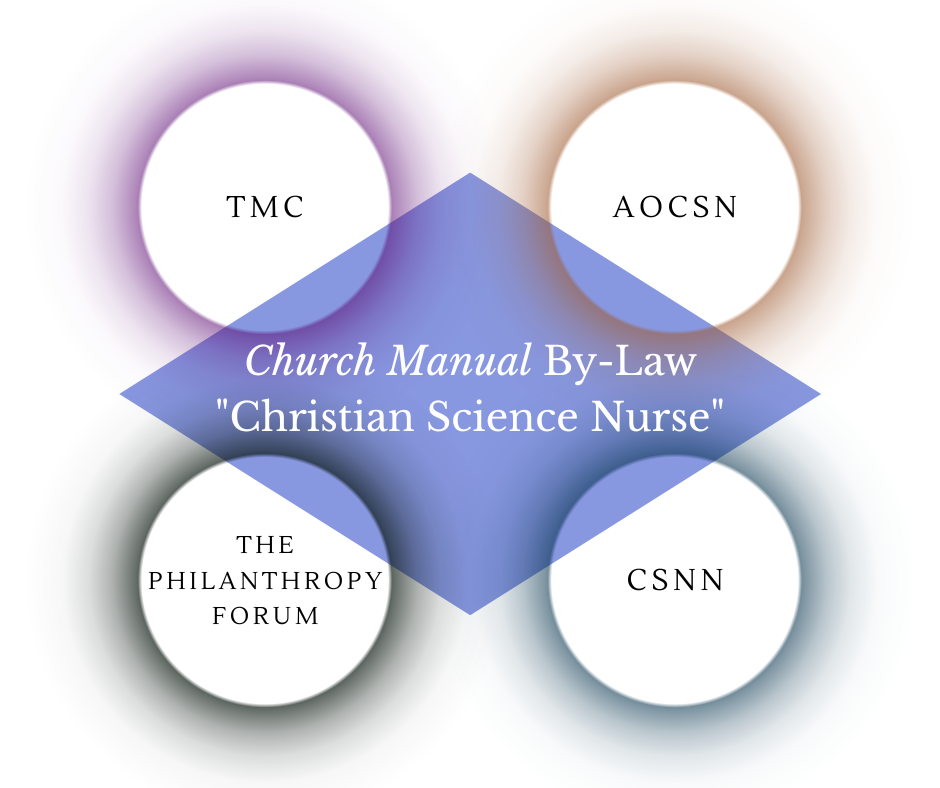
The Collaborative’s components are: Christian Science nurses, Christian Science nursing facilities, Christian Science visiting nurse services and Christian Science nurse professional associations, The Mother Church, and other supporting organizations.
The Five Priorities of the Collaborative:
A sufficient number of trained and qualified Christian Science nurses to meet the need.
A consistently high standard of Christian Science nursing understood and demonstrated throughout the field.
The Manual by-law “Christian Science nurse” understood and appreciated by all church members.
Church members inspired by a natural desire to care for one another.
Individuals and organizations discovering and developing better ways for working collaboratively to accomplish these priorities.

-
— supports the creation of courses to meet the continuing education requirement for Journal-listed nurses.
CEWG brings together Christian Science nursing educators and mentors from organizations and programs around the world, working in partnership with The Mother Church to ensure robust, relevant, and practical continuing education is available to all Journal-listed Christian Science nurses.
CEWG collaborates closely with the AOCSN Education Committee to encourage a wider offering of high-quality courses and to create opportunities that help Christian Science nurses fulfill their continuing education requirement for Journal-listing. The group and also serves as a hub for educators to share knowledge and resources for courses offered both online and in person.
-
— supports leadership teams in Christian Science nursing facilities.
L&MWG supports the leaders and managers of Christian Science nursing organizations by helping them address the practical challenges of their work from a metaphysical standpoint, and supporting them with shared insight from other experienced leaders. The group continues to collaborate with leaders across the field to develop presentations and resources on the topics leadership most needs right now.
-
— addresses the barriers practicing nurses may meet in getting the training they need to become Journal-listed.
TrAAWG works to make Christian Science nursing mentoring and training both affordable and accessible — developing cross-organizational efficiencies in mentoring for the field and identifying and addressing the funding gaps that make field mentoring difficult to sustain.
-
— advocates for and supports local Christian Science communities in working together to care for each other.
COCC helps cultivate and support the growth of Communities of Christian Caring throughout the Christian Science movement. The group works closely with other parts of the Collaborative to develop helpful resources for Christian Scientists about supporting those with simple needs that do not require the skill of a Christian Science nurse.
The 9-Step Process of a Working Group
How ideas become practical solutions through our Collaborative efforts
(click to expand each step)
-
The idea may come from an individual, or any group.
Take it to the Collaborative Coordinating Committee (C3) for consideration and for suggestions about how to proceed.
Send your idea to info@csncollaborative.org
-
Determine the focus of the specific idea and share it with the C3:
What is the core focus of this project and what are its boundaries?Who does it help?
Is it an unnecessary duplication of work already taking place?
Does this respect and support Manual-based activities of the Mother Church?
Does it address one of the five priorities of the Christian Science nursing community?
-
Is this uniquely a collaborative opportunity, and can we achieve this better than others could working separately?
Would a collaborative effort bring wider resources and create greater efficiencies?
Have we done research in the field to determine the actual need and any other efforts taking place?
Does this compete with or encroach upon any other organization's mission or goals?
Are there others we can work with in collaboration to be more effective in this effort?
Are you willing to work with others outside of your startup group?
-
If C3 approves the project, it will offer a liaison/coach to your working group as well as the support of the Collaborative Support Team (CST).
With the help of the CST, set up meetings with your group, other individuals, and organizations.
-
The working group talks, examines, and develops its ideas. It may conduct research, write a report, and do exploratory work. At this stage, the committee should check in with the Manager of Christian Science Nursing Activities, The First Church of Christ, Scientist, to ensure support for the Church Manual by-law.
In some cases, the working group may need funds to accomplish its work. When funding is needed, the working group will make proposals for support to the Philanthropy Forum. -
The working group makes the idea practical. It does more research, writing, or a survey to get to a viable and practical solution. Some funds may need to be raised here for a survey or consultant fees.
-
The working group asks the C3 and others to assist by reviewing and giving input on the proposal — broadening the review to others who might make edits and suggestions and help refine the work to date. Are there others in the wider Christian Science community that might support this project and be willing to endorse it?
-
What place would be the best "home" for launching and implementing this working group's proposal?
What group has the aligned values, staff, and skill?
Do you need to contact a non-profit attorney for advice?
Ask the board of the organization if they would consider taking this proposal on as one of their programs.
Alternatively, reassess the topic and determine a way to work on it continuing within the Collaborative — the group might not need funding but would benefit from the informational pool the Collaborative provides.
-
The responsibility shifts from the working group to the new organization, which will find the resources, identify funding, develop working policies, launch and roll out the project, and continue to manage it. The working group and CST support usually end at this point.
There are several options: a clean handoff where the new organization takes full responsibility (example: The Principle Foundation took on the National Fund for Christian Science Nursing as a program), or a fiscal sponsorship where the group retains some autonomy but works under the sponsor's legal and financial structure (example: The Principle Foundation is a fiscal sponsor for the Communities of Christian Caring).
Another option is to finish the work and close the group — in this case, a final report submitted to the C3 is appreciated.
This website is overseen by the individuals and groups who are participating in this collective work, and it is managed by the Collaborative Support Team under the guidance of the larger Collaborative.
For a newsletter that brings you the latest on what the Collaborative is doing — see Latest News
For more information, or if you would like to be added to our email list, contact us at info@csncollaborative.org.